
Beautiful Pulsating Web
Laura Põld
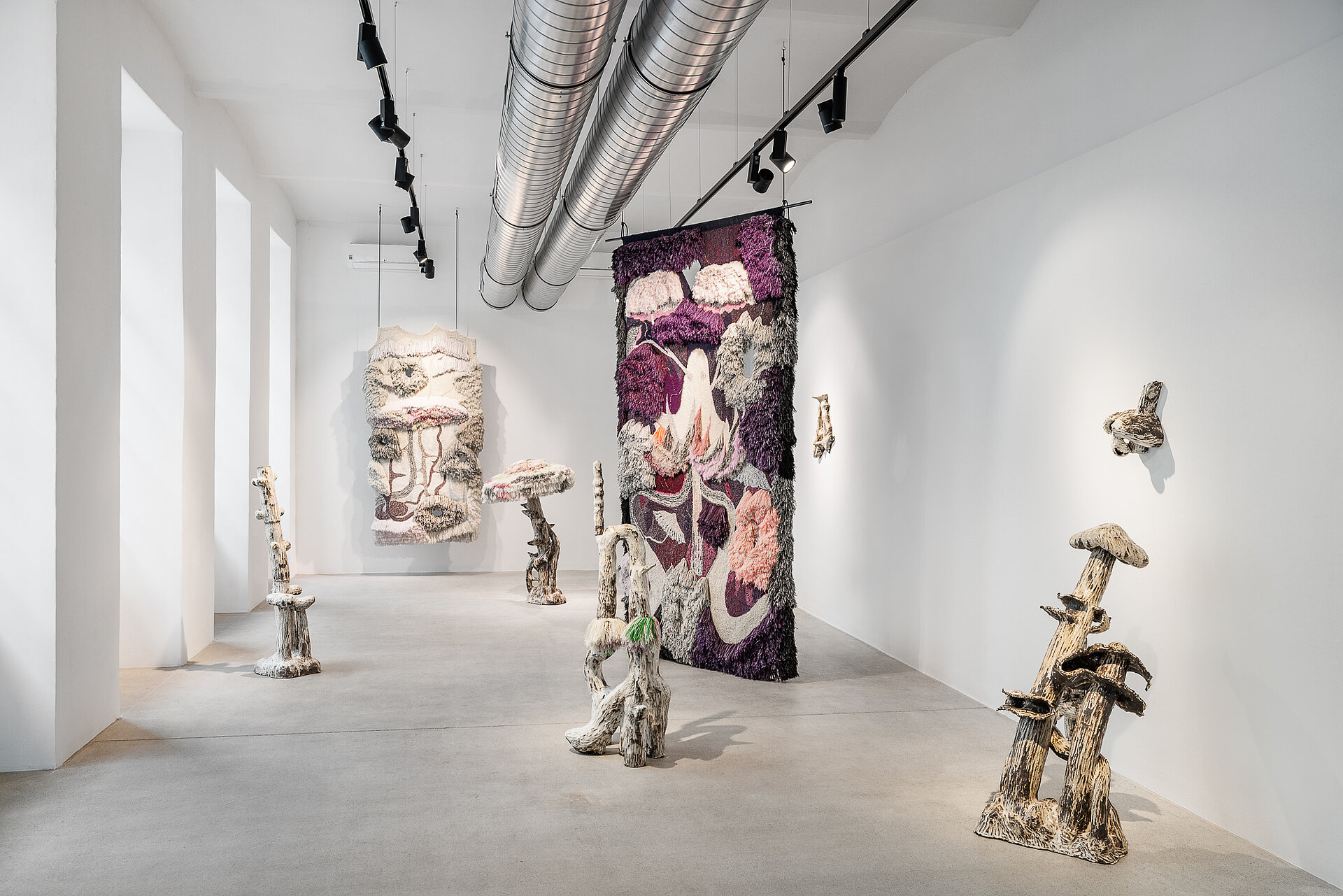
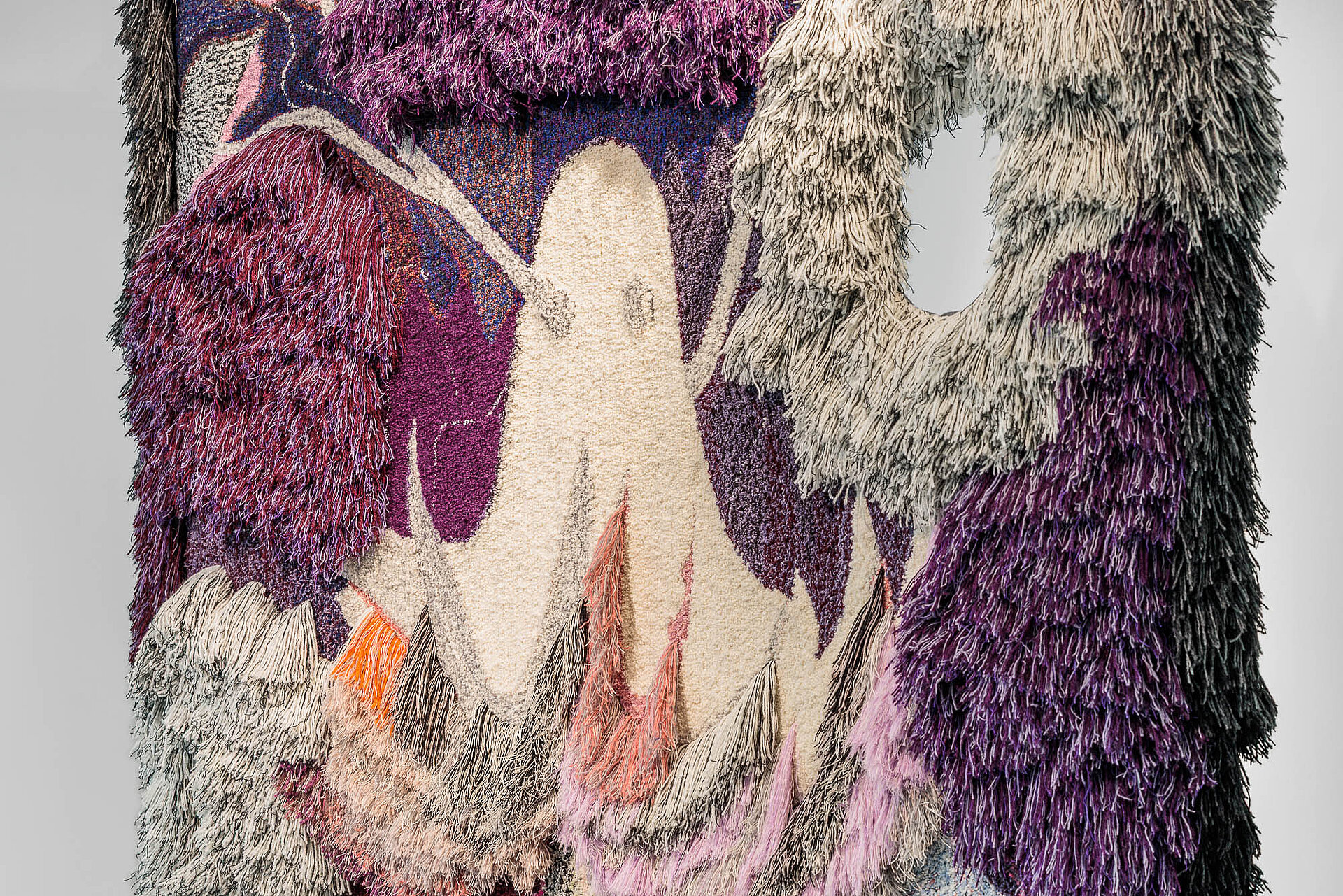
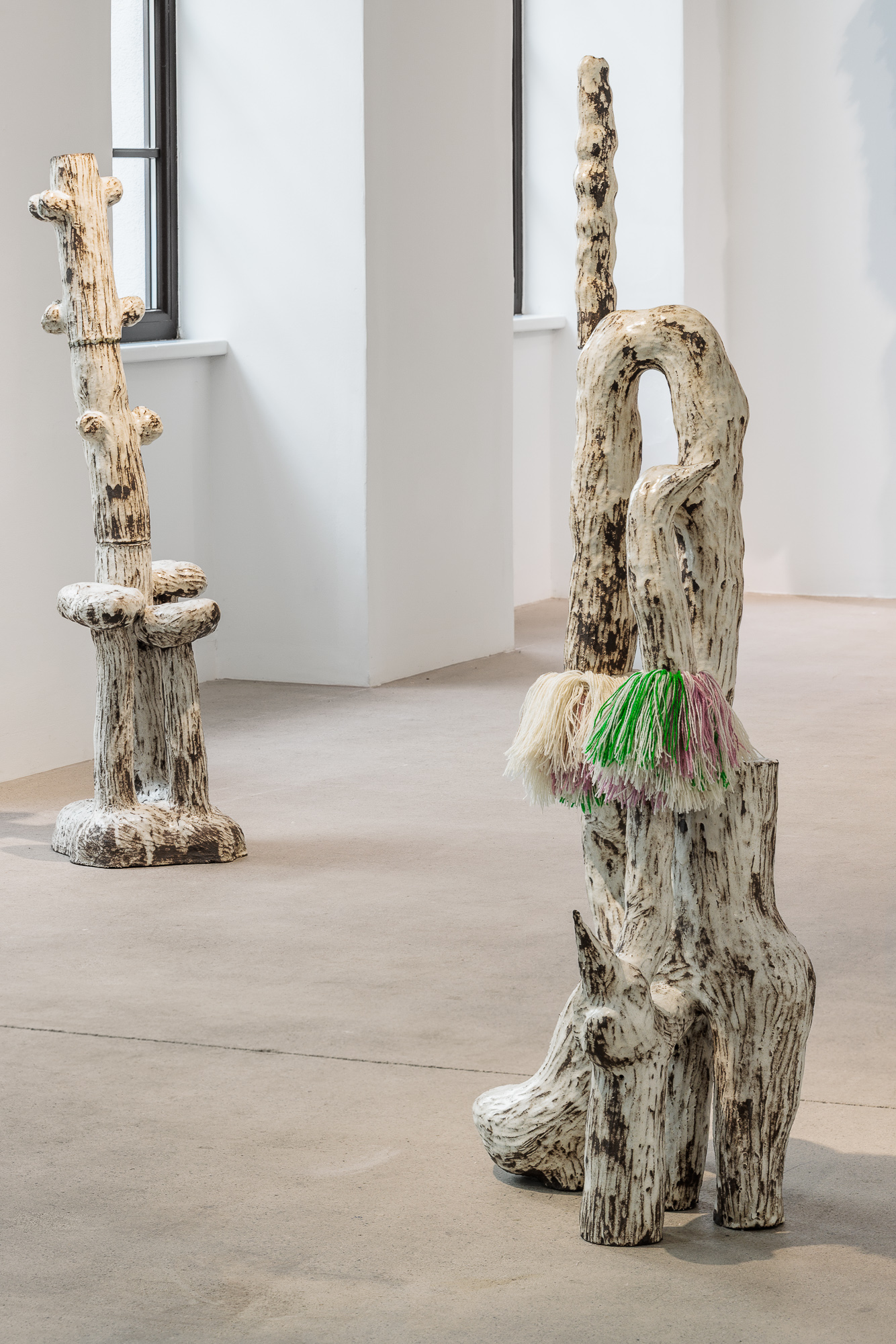
In her new textile and ceramic works at the Eva Kahan Foundation, Laura Põld continues her longstanding exploration of alternative modes of knowing. Moving beyond the dominant assumption that thought begins and ends with human perception, she grants agency to fungal and vegetal life. Her large hand-tufted rugs and sculptural ceramic ensembles are populated by proliferating rhizomes, hybrid plant-bodies and apertures that behave like vigilant orifices, interrupting the persistent fiction that cognition is a human monopoly.
The organisms in Põld’s works appear vaguely familiar, yet they carry an element of uncanniness. Figures we are accustomed to reading as passive, or simply too slow, too distant from our linguistic and perceptual frameworks to register as agents, are here endowed with their own authority. Their gazes, and the occasional human-like detail such as feet and eyes, emerge through holes, fibres, and branching threads. In their dispersed, non-human-centred presence, they gesture toward what Michael Marder terms “plant-thinking”: a form of thought that unfolds without the familiar coordinates of human cognition, imagery or intention. Instead of appearing as passive forms, these organisms come across as active interlocutors, beings whose perceptual field meets the viewer’s, disrupting the idea that looking is a one-way exchange.
The exhibition’s mode of thought is inseparable from its materials. Põld often works with hand-dyed natural wool gathered from friends, acquaintances, and collaborators, as well as store-bought yarns that enter her material ecosystem. The fibres range from high quality hand-dyed wool to synthetic, almost plastic Soviet-era yarns, which she deliberately mixes together. In this sense, Põld forages wool much like one forages mushrooms: collecting, sorting, testing, sensing histories woven into the material. In Nordic–Baltic tradition, wool carries its own mythologies and everyday knowledge, linked to ideas of protection and fate, present in belts, headdresses, and burial cloaks, and passed down through generations through the patterns and seasonal practices of spinning and weaving. It is a material of protection and endurance: retaining warmth in the cold, shielding from heat in the summer. An adaptive fibre shaped by climate and husbandry. In a time of environmental precarity, its thermal intelligence offers a logic of survival through adaptation rather than extraction.
The production of the works mirrors their conceptual framework. Põld collaborates with craft specialists, often women of different generations, who gather in her studio to tuft, sew and assemble the large-scale pieces. These meetings function as forms of collective world-building: spaces of shared labour, conversation and skill exchange. Knowledge circulates horizontally, much like mycelial networks beneath the forest floor.
Põld’s engagement with post-anthropocentric thought does not collapse into dystopian pessimism. While her works expose the limits of a human rationality that has long positioned itself as master of the natural world, they will not fall towards apocalyptic paralysis. There is wit and even sass in the ceramic fungal bodies, whose curling tendrils and assertive stances make sure you understand they have something to say.
Fungi thriving in the irradiated zones around Chernobyl, growing toward radioactive light rather than sunlight, offer a potent metaphor. Life adapts, the organism reroutes, it finds nourishment in unlikely conditions, and so we can see the stubborn creativity of living systems beyond human control.
The exhibition is curated by Lilian Hiob-Küttis
LAURA PÕLD (b 1984) is an interdisciplinary artist working within an expanded field of sculpture, where ceramic and textile-based works bridge sculptural form and pictorial surface.Drawing on mythology, folklore, and environmental history, Põld explores interspecies entanglements and forms of embodied knowledge, foregrounding practices of care, shelter, and survival within unstable contemporary conditions. Her site-sensitive installations often respond to architectural and ecological contexts, proposing material encounters where human and nonhuman agencies coexist.
Põld lives and works between Tallinn and Vienna. She holds a BA in Ceramics from the Estonian Academy of Arts, an MA in Painting from the University of Tartu, and an MA in Sculptural Conceptions and Ceramics from the University of Art and Design Linz. She currently works as a Visiting Associate Professor at the Estonian Academy of Arts, Department of Installation and Sculpture. Põld’s practice moves fluidly between art, craft, and ecological thinking, embracing material agency, slow processes, and the quiet intelligence of making as a form of resistance and continuity.
LILIAN HIOB-KÜTTIS (b 1991) is a curator and gallerist with extensive international experience. Her professional background includes long-term work at Temnikova & Kasela Gallery, where she was responsible for coordinating major international projects, planning and managing participation in art fairs, and overseeing large-scale exhibition productions, alongside the gallery’s daily operations. She holds a Master’s degree in Art History and Visual Culture from the Estonian Academy of Arts.
Hiob-Küttis is a guest lecturer in the Curatorial Studies program at the Estonian Academy of Arts and teaches the course “The ABCs of Art Collecting” at the Academy’s Open Academy.
She has collaborated with a number of leading organizations, including Synlab, Sunly, Taad Foundation (Vilnius), and VKG Group. Her forthcoming curatorial projects include a solo exhibition by Laura Põld at the Eva Kahan Foundation (Vienna and Budapest) and a group exhibition at Kai Art Center. In 2026, she will serve as Artistic Director of the art fair Foto Tallinn.
Laura Põld - Beautiful Pulsating Web
March 18th – June 29th 2026
Kahan Art Space Vienna | Große Pfarrgasse 7, 1020 Vienna
Opening times:
Wed – Sat 6 – 10 pm - and by appointment
admission is free